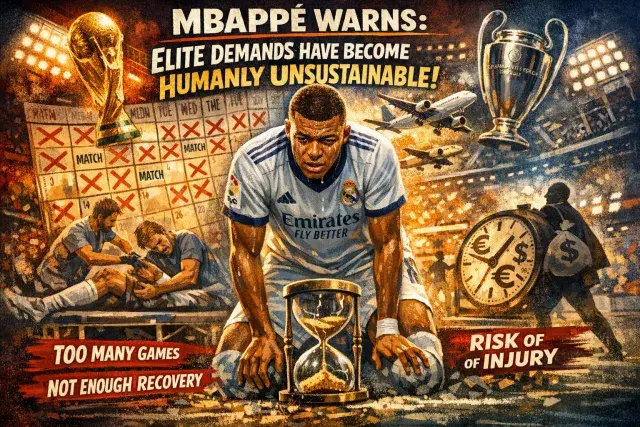
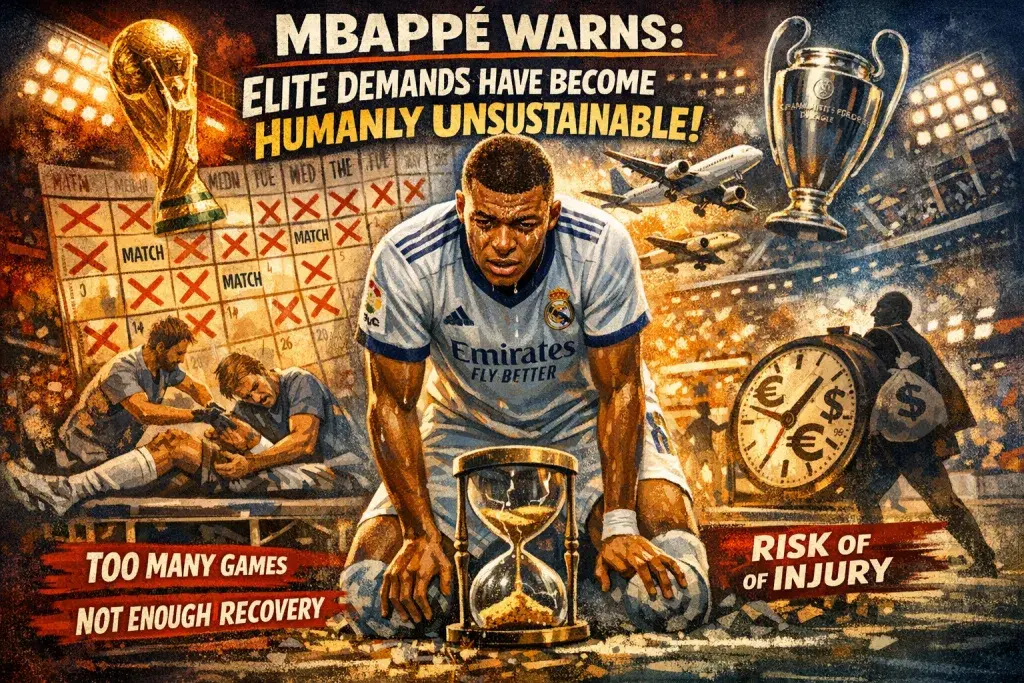
Kylian Mbappe, one of the most decorated footballers of his generation, has publicly declared that the relentless expansion of elite competition schedules has pushed human performance capacity past its realistic limits. Speaking to GQ España, the 26-year-old Real Madrid forward described the current moment as an "era of excessive consumption," arguing that consistency — not raw talent — now determines who survives at the top. His remarks crystallise a growing tension between the commercial ambitions of governing bodies and the physiological reality of the human body.
The Body Cannot Be Scheduled Around Revenue
Mbappe's words land at a moment when the calendar governing elite football has expanded significantly. The broadening of the FIFA World Cup format, the restructuring of the UEFA Champions League to include additional fixtures, and the continued density of domestic competition have collectively added a substantial number of high-intensity engagements per season for those competing at the very highest level. This is not a minor administrative adjustment — it is a structural shift in the volume of elite physical output expected from a small group of individuals, year after year, with minimal meaningful rest.
Human physiology does not bend to commercial timelines. Recovery from high-intensity physical exertion requires not just passive rest, but active biological repair: muscle tissue regeneration, central nervous system recovery, hormonal rebalancing, and cognitive restoration. When these processes are compressed or interrupted — as they necessarily are across a congested calendar — the risk of injury rises, output declines, and the margin for sustained excellence narrows sharply. This is not a matter of willpower or professionalism. It is basic biology.
Consistency Has Replaced Brilliance as the Defining Currency
Mbappe's observation that "talent isn't enough" deserves more than a passing read. What he is describing is a structural shift in what elite performance actually requires. The era of the occasional, transcendent performance — the kind built on freshness, spontaneity, and physical peak — is being displaced by a demand for mechanical reliability across an ever-longer sequence of high-stakes occasions. That is a fundamentally different ask, and one that carries real psychological weight.
Performers in any high-demand field — whether surgical, artistic, or physical — are subject to the same underlying truth: excellence degrades under chronic overload. The psychological literature on burnout is unambiguous on this point. When external expectations remain elevated while internal resources are depleted, the gap between what is demanded and what can be delivered becomes a source of sustained stress. Mbappe, for his part, was careful to frame his position not as complaint but as gratitude — describing his career as "a gift from God" and expressing genuine love for his craft. That framing matters. It signals that the concern is systemic, not personal.
A Broader Reckoning With the Economics of Human Output
What Mbappe is articulating — even if unconsciously — is a critique that extends well beyond his own profession. Across elite performance cultures, the logic of maximum extraction has become dominant. Governing bodies, broadcasters, and commercial partners have strong incentives to expand the number of premium events, extend seasons, and fill every available window with content that commands audience attention and licensing revenue. The individuals at the centre of this system carry the physical cost of that logic.
This dynamic is not unique to elite physical competition. It mirrors broader cultural patterns in which the most visible and commercially valuable performers — in entertainment, in finance, in high-stakes medicine — are expected to operate at peak capacity indefinitely, with recovery treated as a luxury rather than a prerequisite for sustainable output. The conversation Mbappe has opened is, at its core, a conversation about what institutions owe the people whose bodies and minds power their revenues.
The question now is whether governing bodies will treat this moment as a genuine signal or absorb it as reputational noise. Mbappe is not the first elite performer to raise these concerns, and the structural incentives that produced the congested calendar have not diminished. Until the economic logic shifts, the gap between what is asked and what the human body can sustain will only widen.